
Family Life for a Shih Tzu,
From Palace to Levittown
Your little guy or gal comes from a long line of pampered companions.
So here is a question worth a quiet moment. What was family life like for the lion dogs of a Chinese palace, and then for the Shih Tzu when the breed was brand new to America?
The day-to-day. Where they slept, what went into dinner, and who looked after them.
To find out, we'll visit two homes.
First, a palace just outside Beijing in 1903, where the empress's own dogs had a marble-floored pavilion near her throne room.
Then an American house in 1955, when the breed was so new to the country that a family with one was among the very first.
The details underneath these stories are real history, gleaned from the writings of Katharine Carl, an American painter who spent about nine months with the court, and of Princess Der Ling, who served as a lady-in-waiting, along with American Kennel Club and breed club records.
Both homes are part of the story behind your own Shih Tzu.
Please note: AllShihTzu is reader-supported, and some of our product suggestions are affiliate links. As an Amazon Associate we earn from qualifying purchases. This is at no extra cost to you and helps keep this site running.
A Palace Household, 1903
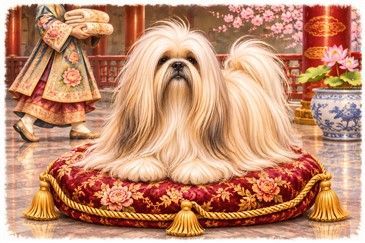
Sixteen miles outside Beijing. On paper, China's ruler is Guangxu. In practice, the power belongs to his aunt and adoptive mother, Cixi ("tsuh-shee").
Her title is Empress Dowager, which means the mother or widow of an emperor, and she has guided the country since her young son took the throne in 1861.
It is August, and we are at Cixi's Summer Palace, a whole town of red-walled pavilions with glazed yellow and green roofs, set among hills, canals and a calm lake.
The courtyards are filled with potted plants, cut arrangements, and seasonal gardens. The scent of jasmine, lotus blossoms, and orchids fills the air.
Her court spends the warm months here, and in winter it will return to the Forbidden City, the enormous walled palace in the heart of Beijing, home to China’s emperors for nearly 500 years.
Hundreds of dogs live in this palace.
Among them are the little lion dogs of the court, close kin to today’s Shih Tzu. Cixi keeps dozens of them herself, in a pavilion of their own near her throne room, where they live a life of luxury.
One of these pampered pets wakes on a silken cushion. Before they can even step onto the cool marble floor, a personal attendant sweeps in and takes them outside for their daily stroll.
Then comes a bath, perhaps followed by a dab of the flower perfume Cixi blends herself.
At midday, the whole court retires for a two-hour rest. Out in the courtyard by the pavilion, this one basks in the sun with the others.
Later, Cixi sets out on her afternoon outing. Six bearers carry her yellow sedan chair, a seat on poles. She sends for this lion dog. The moment they see her, they dash to her side, ignoring everyone else.
At a spot overlooking the lake, Cixi sits on her camp-stool, and the lion dog settles at her feet, right where they want to be. She pats their head and strokes their silky coat.
As evening falls, dinner arrives, and it is no afterthought. The menu is diced liver, rice and a spoonful of gravy. Cixi inspects the meal before the lion dog's attendant serves it.
At night, the palace grows quiet, and the lion dog curls up on their silken cushion, where the day began, fed, warm and much loved.
A Turning Point
The palace world does not last. Cixi passes away in 1908, and four years later the dynasty comes to an end. The little lion dogs of the court begin to scatter.
Around 1930, an Englishwoman named Lady Brownrigg, who lives in China and whose husband is a British general, brings a few of these dogs home to England. Slowly, they win people over.
A breed club forms in 1934, and in 1935 comes the first standard, the written description of what a Shih Tzu should look like.
In 1940, England's Kennel Club gives the breed its own register. Even so, the numbers there stay small, with around 100 at that point and about 700 by 1955.
Here is the amazing part. Every Shih Tzu alive today, all over the world, descends from just 14 dogs: 13 brought to England and Scandinavia between 1928 and 1952, plus one Pekingese added in 1952.
This is because back in China, things take a sad turn. In 1949, the Communist Party takes control of the country. Pet dogs, seen as a luxury of the wealthy, are banned in the years that follow, and the breed nearly vanishes from the land where it began.
By the 1950s, the story is ready to cross the Atlantic.
A Suburban Household, 1955

Levittown, New York. The houses on this street are compact and nearly alike, with two bedrooms apiece.
In one of them, Mom, Dad and their two children have a little Shih Tzu, a breed hardly anyone in America has ever seen.
This one came from an English breeder and crossed the ocean with Dad, one of several servicemen who brought a Shih Tzu home after their tour of duty in England.
Far from this street, a handful of breeders and owners are working to get the Shih Tzu noticed.
This very year, the American Kennel Club lets the breed into its Miscellaneous Class, a waiting room for newcomers not yet fully recognized. Two years from now, those fans will start the Shih Tzu Club of America.
Full recognition is still 14 years away, and by 1961 just a little more than 100 Shih Tzu will be registered in the whole country. On this street, they are still a mystery.
The Shih Tzu wakes on a wicker bed in the kitchen, the floor warm from the hot pipes running beneath. Mom greets them with a scratch behind the ears, and since she is home most of the day, this Shih Tzu has company.
Breakfast comes once Dad is off to work and the children are out the door for school: a half can of Ken-L-Ration, one of the best-known dog foods in the country, made from lean horse meat. A spoonful of last night’s scraps goes on top. The Shih Tzu laps up every bit.
After following Mom from room to room, the Shih Tzu takes a break for a nap and then some playtime with toys. Favorites are a squeaky rubber slipper and a knotted rope to tug on.
By mid-afternoon, the children are home from school, and the Shih Tzu is at the door before the first shoe comes off.
School bags drop, play clothes go on, and one child offers the Shih Tzu a Milk-Bone treat. Out back, the ball sails across the yard and the Shih Tzu races the children to it.
Right before Mom starts dinner, she takes the Shih Tzu out for a walk, and the neighbors wonder what kind of dog this is.
One guesses Pekingese. Another says Lhasa Apso, which is a fair guess, since many of the first Shih Tzu in America were registered as that breed. When Mom tells them the real answer, she gets puzzled looks.
At dinnertime, the Shih Tzu finishes the other half of their canned food and wanders under the kitchen table, hoping for handouts. Dad quietly lowers a bite of pot roast, and the youngest, giggling, passes along a crust of bread.
As the day winds down, the family gathers in the living room around a small black-and-white TV to watch The Adventures of Rin Tin Tin. The Shih Tzu climbs onto a child's lap, and a hand rests on their back.
At night, the television goes dark and the lights go out one by one. The children say goodnight, giving the Shih Tzu a last pat on the head.
The Shih Tzu walks back to the bed in the kitchen, circles once and settles, the floor still warm. The whole family is only a room away.
Today
By 1969, the year of full American Kennel Club recognition, the United States had nearly 3,000 Shih Tzu dogs. In 1978 alone, close to 15,000 were registered.
Now, no neighbor has to ask what kind of dog this is. But the breed did not get here on its own. It got here one household at a time.
From a palace pavilion to a Levittown kitchen, the Shih Tzu traveled only because a family opened the door at each stop. Every home carried the story a bit further.
So, this breed's journey belongs to its families, each one with a spot ready for a Shih Tzu.
Your little guy or gal is the newest chapter, and your family is the one writing it.
Want to spend more time with Cixi and her lion dogs? Most of the history in this article comes from one eyewitness account, and it's well worth a read: With the Empress Dowager of China by Katharine A. Carl.
In 1903, Carl, an American artist, was invited to paint the Empress Dowager, the first Western-style portrait ever made of her. She spent about nine months at court, walking the gardens with Cixi, slipping off during the afternoon rest to play with the palace pets as they sunned themselves, and even receiving a pup as a gift.
First published in 1905, her book offers a rare look at imperial China in its final years.
Delicious Treat Lists:
Best Cheese Snacks for a Shih Tzu - Is your Shih Tzu obsessed with cheese? See tips for selecting healthy cheese at the market and the best wholesome cheese-based dog treats, including a lactose-free options that's offers tons of flavor.
The Best Fish-Based Treats for Shih Tzus – Many Shih Tzu dogs just can't say no to fish. Whether you're working around allergies or looking for a super-healthy option that keeps your Shih Tzu happy, check out these top treats packed with omega-3.
Top Treats for Shih Tzus with Sensitive Stomachs – If your Shih Tzu has a tummy that’s quick to protest, finding the right treat can feel like a guessing game. Thankfully, there are gentle options that dogs find super-delicious. See our list of the best belly-friendly treats.
More Helpful Articles for You:
Top 5 Preventable Health Issues in Shih Tzus - It's not inevitable. Though this breed is prone to these conditions, there are proactive steps you can take to greatly reduce the severity, delay onset, or prevent the issue. Use these recommendations to help your sweetie stay active, pain-free, and well-cared-for throughout every life stage.
Shih Tzu Supplies - Having the right items can improve everything from how your Shih Tzu does when home alone, to their success with housebreaking, and can even help prevent tracheal issues. See what is needed and why, for optimal health, comfort, safety and happiness.
10 Must-Haves Under 10 Buckaroos - On a budget but still want the best for your Shih Tzu? These clever care items are all easy on the wallet and big on everyday comfort, convenience and cuteness.
Genius Gadgets That Make Life with a Shih Tzu Easier - Clever tools, handy devices, and helpful doodads that make daily routines easier and a whole lot more fun for both you and your little guy or gal.